jungle lodges in bandhavgarh & kanah india  
jungle lodges in bandhavgarh & kanah india jungle lodges in bandhavgarh & kanah india
jungle lodges in bandhavgarh & kanah india
jungle lodges in bandhavgarh & kanah india About Us jungle lodges in bandhavgarh & kanah india Gallery jungle lodges in bandhavgarh & kanah india Bandhavgarh Jungle jungle lodges in bandhavgarh & kanah india Kanha Jungle jungle lodges in bandhavgarh & kanah india Book Now jungle lodges in bandhavgarh & kanah india Tiger Movement Map
jungle lodges in bandhavgarh & kanah india
Tiger facts
jungle lodges in bandhavgarh & kanah india

THREATS TO THE TIGER

Today tigers face increasing threats from humans. In order to successfully protect it, we need to address all the issues together. The three major threats are:

Habitat destruction: Due to a rapid human population increase the Tigers natural habitat is shrinking fast. Land that was once covered with pristine forest is now used for agricultural. Even protected areas are under pressure. Several Reserves have human settlements inside and around them. Rampant grazing by livestock destroys the grassland habitat of the Reserves. This leaves less food for the prey base of the tiger, reducing their population drastically. This in turn drives tigers to move out of the protected areas in search of food, rendering them defenseless against poaching, which is the other major threat to tigers.

Poaching of tigers is on the rise. In fact, recently huge populations of the Royal Bengal Tiger have been obliterated by highly organized poaching mafia. The demand for tiger parts comes mainly from China. The Chinese use every part of the tiger for traditional Chinese medicines, believed to cure a range of illnesses. The porous border between India and Tibet makes it very easy for wildlife traffickers to pass in and out of it. In addition there are areas where the prey base of the tiger has been poached, resulting in a drastic decrease in population. An example of this is the situation in Russia. The population of deer and Wild Boar has been reduced so drastically that the tigers have no choice but to resort to killing live stock.

Population Fragmentation: Due to human population explosion, fragmentation of forests taken place. Population of tigers gets isolated, leading to in-breeding. Although this poor gene pool of tigers may not effect the population of tigers immediately, it will have drastic effects in the future. Tigers will have lower fertility and birth defects, which will lead to the rapid decrease of their population.
 

DID YOU KNOW THESE FACTS ABOUT TIGERS?

  • Scientific name of the Tiger: PANTHERA TIGRIS.
  • Tigers are the biggest cats in the world, weighing up to 500 pounds and 6 feet in length, not including a 3 foot tail.
  • Tigers have been classified into 5 subspecies. These are the Royal Bengal, Siberian, Indo-Chinese, South-china and the Sumatran tiger.
  • The Bali Tiger is now extinct. Loss of habitat was the main cause of this subspecies extinction.
  • Contrary to popular belief a white tiger is not an albino. It is a genetic condition, which almost completely eliminates the normally orange pigment of the fur, making it white. However they do have the normal black stripes. Interestingly, the first white tiger was captured in the state of Rewa in India. This tiger was then bread with a normal tiger. The first attempt yielded the normally coloured tiger cubs. However, another attempt was made by mating the white tiger with another female tigress. This time the litter consisted of white tiger cubs. Soon, the white tiger was bread for zoo’s all over the world.
  • Tiger cubs don’t open their eyes until they are 15 days old. They depend on their mother’s milk for at least 3 months, before they started moving around with their mother and start eating meat. They are full independent after approximately 2 ½ Years. By then their mother would have taught them all the relevant skills they need to successfully hunt down prey. The tigress literally pushes the cubs out of her territory, which encourages them to fend for themselves.
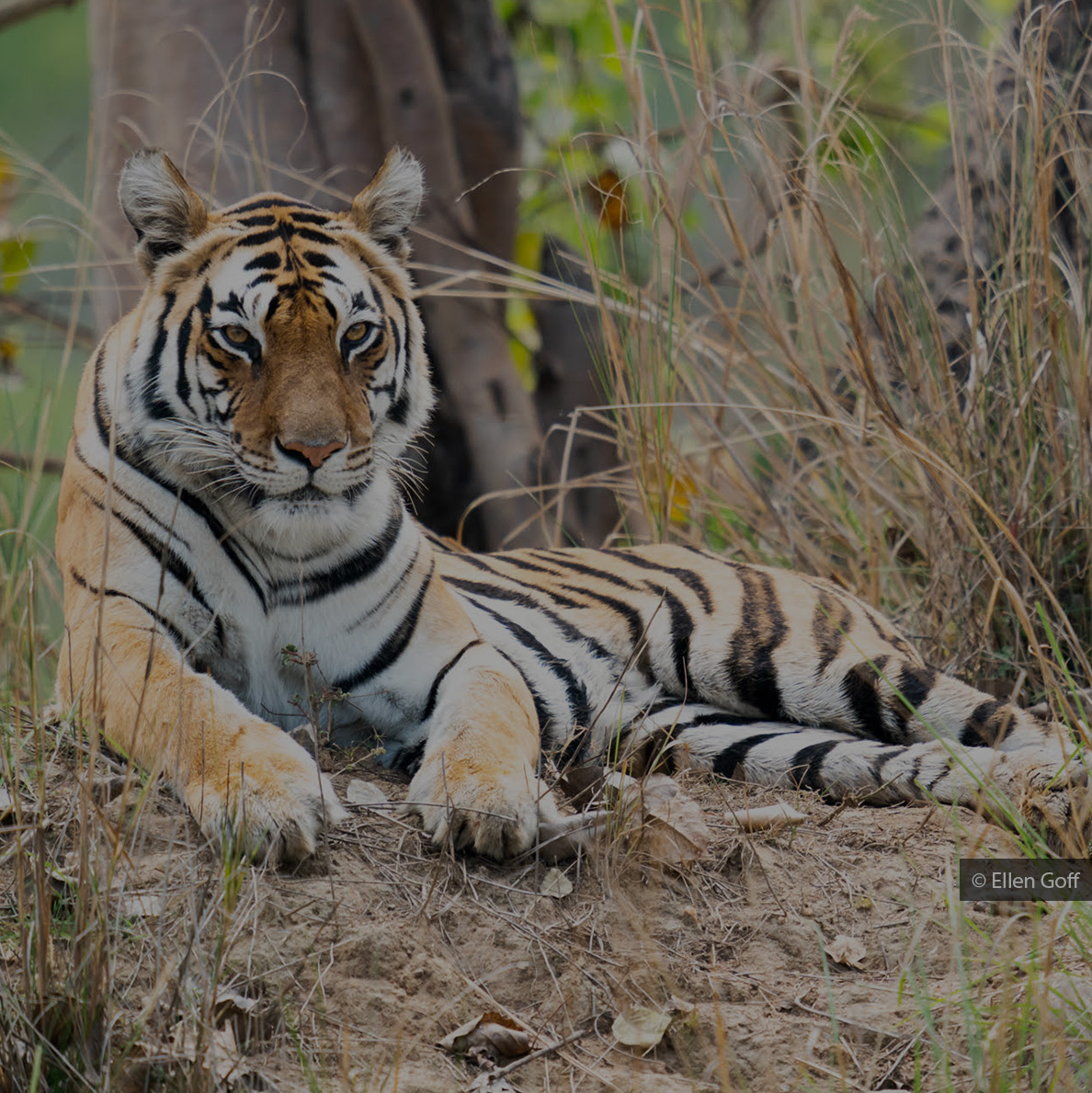
  • Just like the human fingerprint, the stripes on the tiger are unique to that individual. In fact people who thoroughly observe the tiger population of an area can distinguish between them.
  • Tigers have enhanced vision as compared to us humans. They see 6 times better!
  • A tiger can eat 80 pounds of meat in one sitting.
  • A tiger makes a successful kill once in every twenty attempts. They are ambush predators and must rely on their stealth and not speed. They hunt mainly at dawn and dusk.
  • A tiger must eat at least once every 7 days. Let us assume a tiger kills mainly deer. Therefore a single tiger kills approximately 52 deer in a Year. Now you know! If there are several tigers in a particular forested area, the prey base in the forest must be sufficient enough to sustain these tigers.
  • Tigers are very territorial animals. The male usually has a large territory that he constantly patrols in search of receptive females (in heat) to mate with. He also makes sure no rival males are in his domain. They use scratching, scent marking and growling to monitor their territories.
  • The gestation per for a tiger is anywhere between 105 to a 110 days. The mother chooses a safe place (usually a natural cave) to keep them during the first few vulnerable months.
  • Just like house cats tigers have retractable claws.
  • India has the largest population of wild tigers in the world. The most recent tiger count yielded a truly disturbing figure. Only 1400 individuals are left.
  • A captive tiger has never been successfully reintroduced into the wild because a human surrogate mother cannot teach the cubs the skills they would have learnt in the forest as cubs.
  • The life expectancy of the tiger is between 10 – 15 Years in the wild, and 15 – 20 in captivity.
  • There are a total of 29 Tiger Reserves in India. They cover approximately 1.17% of the total geographical area.
  • Tigers do not exist in Africa and never have.
  • Last but not the least Tigers are on the list of endangered species. Radical conservation steps need to be taken to save this beautiful animal from extinction.
 
 
jungle lodges in bandhavgarh & kanah india
jungle lodges in bandhavgarh & kanah india jungle lodges in bandhavgarh & kanah india
jungle lodges in bandhavgarh & kanah india Tiger Operators for  welcome Heritage  Govt. In India  FH&RA jungle lodges in bandhavgarh & kanah india
jungle lodges in bandhavgarh & kanah india jungle lodges in bandhavgarh & kanah india   jungle lodges in bandhavgarh & kanah india jungle lodges in bandhavgarh & kanah india
Copyright © 2008, Tiger Resorts Pvt. Ltd. All Rights Reserved.